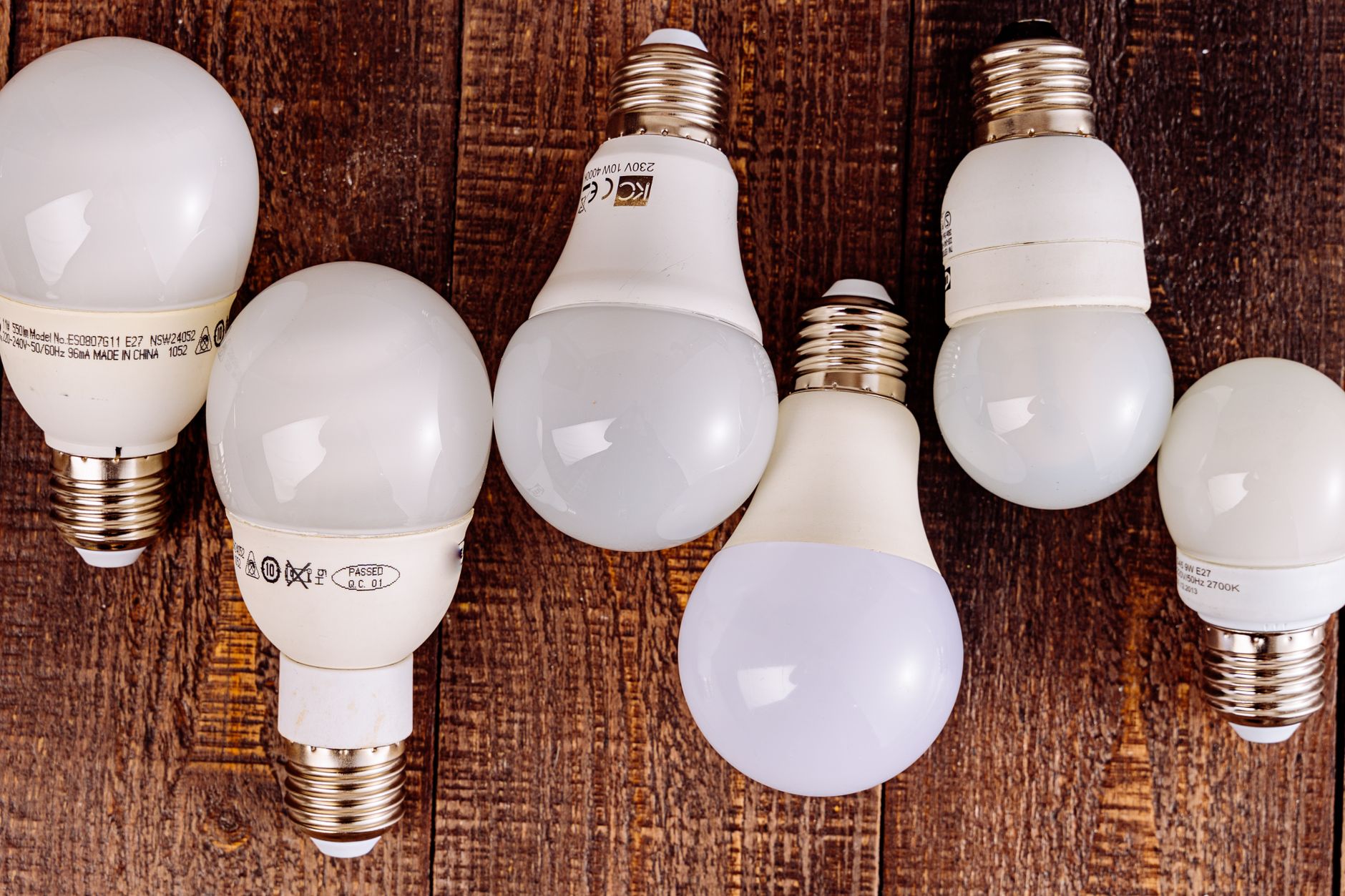

Your annual savings from switching to LED bulbs depend heavily on which bulbs you’re replacing, how long you use them daily, and your local electricity rates—but estimates suggest households that replace all their bulbs can see savings ranging from modest (under $20 per year) to significant (over $100 annually), with longer payback periods in homes with lower usage. The math centers on one fact: LEDs consume roughly 75 to 80 percent less energy than incandescent bulbs while producing comparable light, though the actual dollars saved per bulb per year typically falls between $1 and $5 depending on those variables. A practical example: if you replace a single 60-watt incandescent bulb that runs 3 hours daily with a 9-watt LED equivalent, the energy difference alone adds up—but that gap compresses or expands based on your electricity cost, current bulb type, and how often the light is actually on. Someone paying $0.12 per kilowatt-hour will see different savings than someone in a region paying $0.18, and a porch light left on 24/7 generates far more annual savings than a bedroom bulb used 1 hour per day.
Table of Contents
- How Much Energy Do LEDs Actually Save Compared to Incandescent and CFL Bulbs?
- Why Your Actual Savings Might Be Much Lower Than Advertised
- Real-World Savings Calculation: A Practical Example
- When Is the Payback Period Shorter Versus Longer?
- Common Problems That Reduce Savings and Shorten Lifespan
- The Hidden Costs of Upgrading Your Entire Home at Once
- How Your Home’s Age and Existing Wiring Affect LED Installation
How Much Energy Do LEDs Actually Save Compared to Incandescent and CFL Bulbs?
LED bulbs typically draw 8 to 12 watts to produce the same light output as a 60-watt incandescent, and roughly 30 to 50 percent less than comparable CFL (compact fluorescent) bulbs. The energy savings gap is largest when you’re replacing old incandescent or halogen bulbs; replacing CFLs with LEDs yields smaller per-bulb savings, though LEDs do offer longer lifespans and faster on-off switching without the warm-up delay CFLs require. Switching from incandescent to LED is the most dramatic efficiency jump available in standard household lighting. Real-world comparison: a single 40-watt incandescent bulb running 8 hours daily for a year consumes about 116 kilowatt-hours of electricity.
The equivalent 6-watt LED running the same schedule uses roughly 17 kilowatt-hours—a difference of approximately 99 kilowatt-hours annually per bulb. At average U.S. residential rates, that electrical difference alone translates into measurable annual savings, though the exact dollar amount varies by location. If that bulb runs longer or more frequently, the savings multiply; if it runs rarely, they shrink proportionally.
Why Your Actual Savings Might Be Much Lower Than Advertised
LED manufacturers and retailers often cite best-case scenarios: maximum daily usage, highest regional electricity rates, and replacement of the least efficient bulbs (old incandescents). Real homes rarely match those conditions. A bulb in an infrequently used closet or guest room might be on only 2 hours weekly, which means even a 60-watt incandescent generates minimal annual electricity cost—perhaps $2 to $4 per year in total expense—so switching it to LED might save only $1 to $3 annually, making payback take 10 to 20 years depending on the LED’s purchase price.
The age and type of bulb you’re replacing matters more than many homeowners realize. If you’re already using CFLs in most fixtures, your existing bills already reflect significant energy efficiency, and swapping to LED adds only modest additional savings. Outdoor lights, security lamps, or decorative fixtures that run infrequently deliver almost no annual benefit—the best ROI comes from high-use indoor lights: kitchen overhead fixtures, living room lamps, bathrooms, and any bulbs on timers or on for many hours daily. A warning: some manufacturers claim 25,000 to 50,000-hour lifespans, yet real-world data suggests actual lifespan can vary significantly based on heat dissipation, driver quality, power surges, and switching frequency—buying the cheapest LEDs to maximize initial savings often backfires when they fail prematurely.
Real-World Savings Calculation: A Practical Example
Assume a household with twelve 60-watt incandescent bulbs running an average of 4 hours daily in various fixtures, at an electricity rate of $0.13 per kilowatt-hour. All twelve incandescents consume roughly 1,051 kilowatt-hours per year (12 bulbs × 60 watts × 4 hours × 365 days ÷ 1,000). Switching to twelve 9-watt LED equivalents cuts that to roughly 158 kilowatt-hours annually—a reduction of approximately 893 kilowatt-hours yearly. At $0.13 per kilowatt-hour, that translates to roughly $116 in annual electricity savings across all twelve bulbs, or approximately $9.70 per bulb annually.
However, most households don’t use all lights equally. Seven bulbs might see genuine 4-hour daily average use (porch lights, kitchen, living room, bedrooms), while four bulbs are rarely used (hallway, closets, guest spaces) and one runs continuously on an outdoor timer. The seven high-use bulbs might generate $60 to $70 in combined annual savings, the four occasional-use bulbs might generate $8 to $12, and the continuous outdoor lamp might deliver $15 to $20. The household’s actual total savings falls closer to $85 to $100 annually—still significant, but lower than the simple calculation suggested. LED bulb purchase cost ranges from roughly $2 to $15 per bulb at retail, meaning payback might take 2 to 5 years for high-use fixtures and 10 to 15 years for rarely used spaces, assuming no premature failures.
When Is the Payback Period Shorter Versus Longer?
Payback periods compress dramatically in homes with high electricity rates, extensive bulb usage, or many fixtures. A household in California or New York, where rates often exceed $0.15 to $0.18 per kilowatt-hour, sees faster payback than one in a state where rates hover around $0.09 per kilowatt-hour. Similarly, a home where most lights operate 5 to 6 hours daily benefits much more quickly than one where usage averages 2 to 3 hours. Homes with outdoor lighting, security lights, or decorative fixtures running 8 to 24 hours daily see exceptional ROI—a single outdoor bulb on a timer running 12 hours nightly for a year can generate $20 to $40 in savings if it replaces a high-wattage incandescent or halogen.
The tradeoff is purchase cost versus payback speed: buying the least expensive LEDs might cut your upfront investment to $2 to $3 per bulb but risks poor quality, flickering, or early failure that eliminates the payback advantage. Mid-range LEDs ($4 to $8) typically offer better build quality and longer actual lifespan. Premium LEDs with smart features or extended warranties cost more but rarely justify the expense for simple energy savings alone—those features appeal to homeowners who want dimming, color control, or integration with home automation, not purely to maximize electricity bill reduction. For purely financial optimization, buying reliable mid-range LEDs for your highest-use fixtures and replacing lower-use bulbs more gradually makes economic sense.
Common Problems That Reduce Savings and Shorten Lifespan
Dimmer switches represent the first major incompatibility issue: standard LEDs flicker or don’t dim smoothly on many dimmers because the driver circuit inside the LED bulb isn’t designed for the dimmer’s rapid switching. This forces you to buy dimmer-compatible LEDs, which cost more and may not resolve the problem entirely. A practical warning: installing a non-dimmable LED on a dimmer circuit can cause rapid flickering, visible cycling, or shortened lifespan because the dimmer’s voltage modulation stresses the LED’s internal electronics. Testing before purchasing in bulk is wise.
Heat dissipation issues shorten real-world lifespan in recessed fixtures, enclosed ceiling domes, or small lamps with limited airflow. An LED bulb rated for 25,000 hours might fail after 8,000 to 12,000 actual hours if installed in a sealed fixture that traps heat around the bulb’s driver circuit. Power surges, poor voltage regulation, and cheap power strips can also damage LED drivers faster than incandescents, which tolerate electrical fluctuations better. A second warning: manufacturer lifespan claims assume ideal conditions (moderate temperature, stable voltage, limited on/off cycling), yet real homes rarely meet those criteria. Additionally, some cheap LEDs exhibit color shift over time—the light gradually yellows or dims without complete failure, making the bulb seem defective even though it’s technically still functioning.
The Hidden Costs of Upgrading Your Entire Home at Once
Replacing every bulb in a home simultaneously requires significant upfront capital—purchasing 20 to 40 LED bulbs at $3 to $10 each means spending $60 to $400 depending on quality and quantity. For a household with tight cash flow, that’s a real constraint, even if the payback comes within 3 to 5 years. A more practical approach for many people involves phased replacement: swap high-use fixtures first (kitchen, living room, outdoor), then gradually replace medium-use and low-use bulbs as old incandescents burn out.
This spreads the expense and lets you test different brands and color temperatures in your actual fixtures before committing to a full household upgrade. Another hidden cost surfaces when upgrading colored or specialty bulbs: architectural accent lighting, outdoor Edison-style decorative bulbs, or color-changing RGB bulbs often carry premium prices and may not exist in equivalent wattage to your old fixtures. A recessed fixture that held a specific narrow-beam 50-watt halogen might have no LED equivalent that produces identical beam characteristics, forcing you to accept different light distribution patterns or rewire the fixture entirely. Warranties on budget LEDs are often 1 to 2 years, while incandescents were essentially unwarranted; if an LED fails at year 3, you’re out the cost entirely, whereas an incandescent failure meant replacing a $0.50 bulb.
How Your Home’s Age and Existing Wiring Affect LED Installation
Older homes with aging electrical systems sometimes exhibit voltage fluctuations that stress LED drivers more than incandescent filaments. A home with loose neutral connections, undersized main panels, or frequent power quality issues may see LEDs fail prematurely despite premium quality, making the payback calculation unreliable. Newer homes with stable voltage rarely encounter this, but aging infrastructure in older neighborhoods or rural areas with long distribution lines can create conditions where LEDs fail faster than expected. If you notice flickering lights even when the home isn’t under high electrical load, voltage instability could be the culprit—consulting an electrician to verify voltage stability before replacing all bulbs might prevent frustration.
Vintage or specialty fixtures designed for specific bulb types can present mechanical compatibility issues beyond just electrical ones. A chandelier socket or lamp base designed for candelabra bulbs (E12) requires appropriately sized LED equivalents, which may be harder to find or more expensive than standard A19 (E26) bulbs. A fixture with very tight clearance between the bulb and a fixture component might not accommodate an LED’s larger heat sink compared to a slim incandescent, forcing you to choose between fixture modifications or keeping the incandescent. These real-world installation constraints mean calculating savings across an entire home requires examining each fixture individually rather than assuming uniform replacement across all 30+ bulbs.